The perception of intimate spaces
- Adriana Rodriguez-villa
- Feb 5, 2024
- 11 min read

Intimate spaces within the home:
In this comparative study I intend to look at how artists portray Intimate spaces within the style of Genre Art. More specifically, I will look at the work of Jan Steen Wealth is looking and Diego Velázquez’s Las Meninas. These works will be contrasted with the interpretations by contemporary artist Tim Mara as an example of how interiors in art have evolved.
Intimacy is defined as ‘to describe an occasion or the atmosphere of a place you like because it is quiet and pleasant, and seems suitable for close conversations between friends’ by the Collins dictionary. Yet the artistic interpretations of the idea of intimacy have evolved as a result of different points of view according to the historical contexts for the artists. To me an intimate space is a place that has a sense of familiarity and privacy.
If I described Genre Art as the portrayal of lively scenes from everyday life then why am I looking at Las Meninas? In my opinion, Genre art is more of an attitude than a category with strictly defined limits. In the 17Th century, public art had political or religious themes and presented heroic, noble or dramatic characteristics. This group portrait, however, presented an honest depiction of individual figures, which usually would be isolated, interacting with the viewer. I will explore this further throughout my written study by comparing Velázquez’s compositions of people with the ones valued in the screen prints of Tim Mara.
In many ways nothing physically changed within the pieces representing interiors. Tim Mara's prints, Diego Velázquez and Jan Steen all share a nostalgic quality. Unfocusing our attention upon the shrewd observation of costumes, and settings we would not be able to differentiate the baroque pieces from the contemporary ones for they convey the same feeling of intimacy.
Genre Art was impulsed by artists such as, Jan Steen (1626 - 1679), an artist who aimed to reflect and entertain the spectator. His techniques focused on the depiction of light, clarity and stillness. Steen, specialised in the depiction of taverns. His family ran a tavern called The Red Halbert for about two generations so it is understood that this space was intimate for him. He focused on joyful and humorous narratives, placing emphasis on groups of people, food and mundane objects, such as the painting below called Wealth Is Looking. There is even a Dutch proverb: "A Jan Steen household" meaning a messy atmosphere for the scenes.
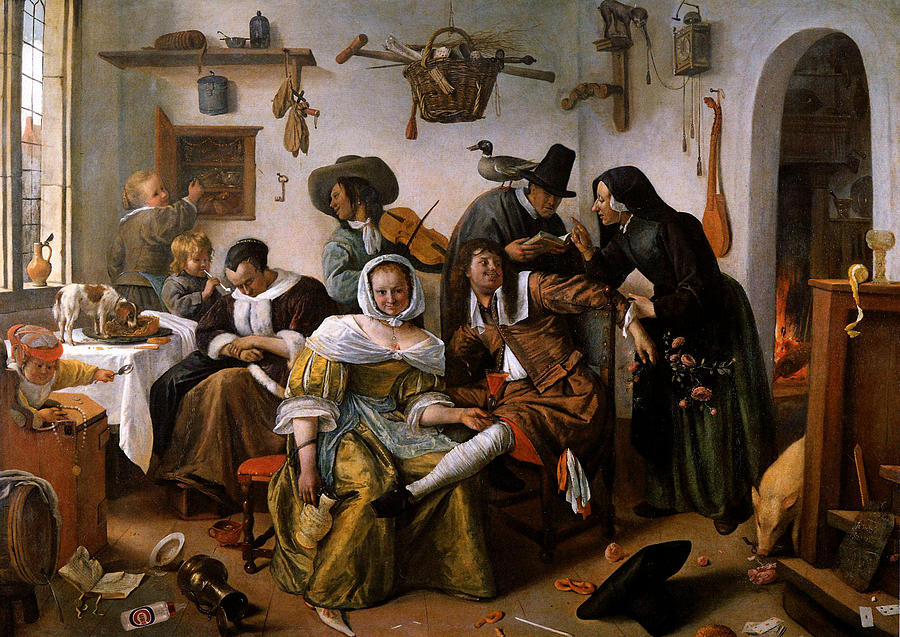
Could we therefore call this scene a household? Jan Steen’s Wealth Is Looking (1663) is a capture of a tavern scene where the wealth of the owner is spilled throughout. The lounge is filled with people interacting with each other. From left to right we can see three unattended children; a woman slumbering; a musician; a woman with a man wrapping his leg around her and two puritan preachers. We assume that the inn-owner is the man with his leg on top of the woman and with a flower crown in his left hand because he seems to be interacting with all figures and is being scolded by the preacher about the excess in the tavern.
The room is brimming with symbolism such as a barrel on the bottom left of the image which is spilling its content and a pig at the other side of the painting holding the tap. This refers to an old Dutch proverb that signifies how the innkeeper is giving away the booze for free. At the bottom right corner, near the pig, there is a piece of slate that has the name of the painting “In Weelde Siet Toe” which roughly translates to “beware of luxury.” This is a warning on how wealth is being managed in this situation. There is also a diploma crumbled on the floor next to the baby, showing the lack of judgement of the owner. As we can see the flower crown has some petals falling from it, referring to the proverb Flowers Before The Swine. The leg around the woman serves as another dutch proverb Legs That Carry Wealth “Het Zijn Sterke Benen”. This position also sexualises the scene as the woman expresses the erotic fantasy of a domestic maidservant. She is gazing, unabashed, directly into the eye of the viewer and has a playful smile on her lips. She is drinking and holds a bottle and a glass in each hand. We assume the head of the household is the woman to the left because of her garments such as her fur coat; she is sleeping insinuating how nobody is caring about the underlying consequences of their actions. The musician is supposedly playing the violin looking suspiciously at the money pockets which the child is touching. In a basket, crutches hang threateningly from the ceiling warning the owner that he may have to use it as a beggars crutch. They also offer a balance in the composition above of the figures. The room brimmed with objects contrast with the archway to the right as well as the window of the left, they provide calmness. The only figure trying to stop the fatal ending from happening is the monkey that is trying to stop the clock by holding the weights, trying to stop time to avoid the tragedy that is unpreventable.
The chaotic scene full of details, both in specific actions and facial expressions of the individuals and the variety of objects, resembles a cluster of memories the artist might have experienced in his childhood. This way we are presented with the artist’s intimate space.
During this same period, 1599-1660, Spanish painter Diego Velázquez mastered the use of light and perspective in his works. Stemming from Velázquez’s strong relationship with the Spanish King Philip IV, the artist tended to portray the aristocracy. However, Velázquez’s use of light managed to maintain an honest character while simultaneously making his subjects feel familiar.
I first encountered Velázquez whilst briskly strolling through the crowded rooms of the Prado museum. Amongst other oils and finely crafted sculpture, my eyes were fixed in a two-way glare with the painter himself. Las Meninas is a picture composed like a scene from a play with the central blonde figure of the five-year old Infanta Margarita Teresa.

It is one of the most recognisable disguised self portraits in the world; Velázquez can be seen in the left hand side of the painting staring directly at the viewer as seen above. The actual painting’s name is The family of Philip IV which for me is an interesting choice for the monarch is not the head figure of the piece. Velázquez plays with the contrast between light and shadow, the distribution of planes and synthesises the colour and shape in areas such as the hand holding a palette which is only defined by the tone of colour.
What is going on in the scene, what is the picture really about? This room is the studio of the painter in the Alcazar Palace. The interruption of Margarita surrounded by her entourage whilst Velázquez is painting the portrait of the royal couple is the narrative for this painting. From left to right in the foreground we can distinguish; Maria-Augustina Sarmiento a lady-in-waiting (a menina) who offers water to the Infanta Margarita; Isabel de Velasco a menina who is curtseying at the viewer; two dwarfs - one looking upwards with her gnarled face, Maribarbola, as well as Nicolas de Pertusato that is tauntingly kicking the mastiff dog. In the middle ground we find the painter himself, Diego Velázquez, and behind las meninas is the governess Marcela de Ulloa and a minder. In the background we can finally register who the suite are looking at, the royal couple is seen from a mirror hanging on the rear wall. Furthermore there is a figure standing in the open doorway which is the marshal of the palace, Don José de Nieto Velazquez.

There is a balance between the density of objects and figures in the study, it is perfectly orchestrated to further enhance the role of the characters. In the foreground we find the “innocent” figures whereas in the background and the middle ground we find the “intellectual” and “mature” figures. It is clear that the monarch’s daughter, Margarita, is the main figure of the painting. She is directly below the vanishing point of the painting. This is shown by her central placing, and the light floods directly on her from the window. Her dress is almost white, further enhancing her as the centre point and the most important figure in the entire piece.


This piece doesn’t lack a symbolic character: the paintings in the background are two copies of the works by Peter Paul Rubens. Both speak about Ovid’s metamorphoses which is the contest between mortals and gods. The one on the left is Minerva Punishing Arachne, while the one on the right is Apollo's Victory over Marsyas.
The influence of this art work is immense. Pablo Picasso, himself painted various versions of the scene; Francisco Goya, painted Charles IV of Spain and His Family in a similar way to Las Meninas in his studio, although it lacked the warm and relaxed environment of the former. It is clear that the artist’s relationship with the subjects is important to express closeness.
In the 1970s there was a search for a modern interpretation of intimacy within spaces. The scene Power Cuts Imminent (1975) by Tim Mara is a modern rendition of Las Meninas.
Tim Mara (1948 -1997) was a printmaker and professor of printmaking at the Royal College of Art in London. Known to be a prestigious lithographer, printer and etcher, he wanted to illustrate familiar scenes with a strong accent on the narrative of personal scenarios. He probed features such as light, clarity and stillness, while exploring other themes such as repeating patterns, reflection, refraction and shadow. Tim Mara used images of both his family and friends to conceive the perfect compositions for his screen-prints. He layered his prints by integrating the people in the background and situated the perspectives on the foreground as foundations for his prints. He required as many as fifty or sixty separately printed colours to depict the rich compositions that were highly influenced and inspired by Velázquez. An important factor which make his works unique are the repetitive patterns which establish the spaces of his compositions.

The vivid colours (the orange of the man’s shirt, the yellow discs and the green tiles) he used could remind the viewer of the pop artsy commercials of the time. However, Tim Mara rejected the title of Pop Art as he treats light following the lineage of the Dutch masters (1600-1672). He considered his work in terms of “old masters in modern dress”.
Tim Mara always tried to integrate his concerns for socio political problems on situations such as the miners strike, power rationing and the oil crisis after OPEP. It was also a decade where people choose to rebel and break away from the gentle, domestic and materialistic way of life promoted by social constructs up to that point. Woman started to play a more liberal role in the society with the sexual revolution and feminism. In the 70’s, Britain had power rationing to help prevent blackouts, one of the worst was known as the “Three-Day Week”. It occurred in 1974 and was the cultural stimuli for the piece.
It is therefore ironic to describe the scene as electric for its vibrant use of colours as it’s based on a situation where there was no electricity.
I call Power Cuts Imminent a scene for the narrative of the piece. It is a print of a living room where in the foreground there is a woman sitting in a couch and a man looking at a television. There is a balance between the figures, two figures in the foreground are stationary whereas the figures in the background are moving. It is unclear what the men in the foreground are doing but they are holding electronic devices on their hands. The piece has 6 figures and explores the wonders of electricity: televisions, elevators, spotlights, phones, etc… The setting itself creates an intoxicatingly electric atmosphere with the amount of luminous devices. Even so, it does not overwhelm the figures inside of the scene.
It seems as if the figures are continuing with their lifestyles as the artist is portraying them. The figure in the foreground to the left of the painting is facing away from the spectator, as if what is showing on the television is more important than acting as a part of the painting. However, is he looking at the television or at the window in which two figures are pampering with some devices. The only figures that establish direct visual contact with the spectator are the man in the elevator and the woman in the couch. I believe that the male figure to the left and the television showing a head is an astute tribute of the disguised self portrait in Las Meninas.
The singularity of this woman in a composition full of male figures expresses the true intentions of Tim Mara; to explore feminism. It contrasts with the cut part of a woman in the elevator which has tried to make a stand (as suggested by the dominant pose she is in). The woman, nonetheless feels distant as her stare longs for liveliness. In my opinion, he is trying to show how this woman is ready to be part of the mechanisms of society and is waiting for the moment to stand up to the oppressive nature imparted to woman.
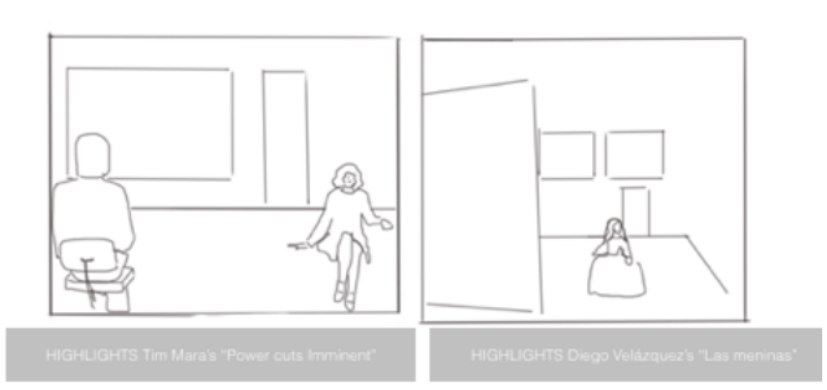
One difference between Mara and Velázquez is the stillness of his pieces versus the movement in Las Meninas. Having seen the similarities between Las Meninas and Power Cuts Imminent in their narrative I then looked at the similarities in the compositions by superimposing the images. I concluded that both these works were concerned with the relation between the figures simultaneously.

In Velázquez’s oil painting three parts of the painting are distinctive from others: the mirror, the door and the Infanta. They are competing centre points which capture the real, ideal and reflected. The real is represented by the man in the background as the door frame enables the perspective of the room expanding out of the painting. The reflected plane is the elderly monarchs hidden by the brightness of the light on the mirror. The ideal is represented by the healthy Infanta, which contrast with the malnourished inhabitants of Spain at that time.
Similar to Velázquez, Tim Mara’s screen-print also has the representation of the real, the ideal and the reflected. In this case, the real is represented by the men in the background, I interpret that the men are holding all of the devices but none of them work as they are not hypnotised by the screen. The television is the reflected realm as we can see the face of the man who is facing towards it. The woman represents the ideal at a time where Women’s rights and the Sexual Revolution seemed for.
It is clear that his use of repetitive patterns contrasts to that of the detailed compositions we tend to think about when looking at Genre Art. As said by Tim Mara “In the hierarchy of fine art, printmaking is usually associated with craft skills — with technique. And that gets in the way. My work was always about the ideas more than the medium”.
This idea of intimacy can be seen as an artistic search for; the three artists analysed their social situations to produce their vision of intimacy. I believe the paintings and the print readily fit into the category of reflecting the culture of their time and all manage to explore a degree of intimacy.
In the 16th century Spanish Empire, Diego Velázquez depicted the decadence of the higher class. He produced an in site to the life of the Royal Family at the time at which Spain had lost a 30 year war against France. He managed to show his appreciation to the family. It also showed inclusion in this nucleus for the audacity of his self portrait in this royal painting. The addition of the Cross of Santiago, after Velázquez’s death, in his chest, manifested intimacy not only between the subjects of the painting, but from the subjects to the artist as a tribute to his relationship with them.
In the 17th century Dutch Republic, Jan Steen explored the lower class; evoking the mentality of “carpe diem” in his paintings he showed the joyfulness of the community he belonged to. In his works the average man and woman were immortalised as fine art, previously the reserve of saints and nobles. Following his understanding of life, he created the pictures not celebratory of the messiness, but as a warning to the viewer in a moralising tone. In my opinion, he wanted to express how there was luxuries to be found in each class, even in the lower class, and how the people should avoid the temptations which bring doom to those who are not careful. Seeing where he grew up, he surely experienced situations that taught him important lessons which he tried to reflect in his works. He was true to the nature of his experiences as well as the closeness to the subject, which in turn showed intimacy in his works.
The lifestyle of the middle class was explored more recently by Tim Mara. There is a direct link to intimacy as his family were the figures for his prints. They seem to lack of undertones until you research the timing of their production. He played with hot topic debates such as the future of woman in the social construct in a simple manner which enabled people to understand the position of his world.
As was stated, all three paintings explore a degree of intimacy. We could translate these threads to be unique to their historical situation, however I believe that the honesty of their works elude the passage of time. I believe that this artist have managed to convey intimacy to the maximum capacity.
Comments